다원의 그림은 미스터리하다. 또렷한 선으로 구체적인 형상들을 그렸는데, 추상화처럼 느껴진다. 그림 속의 형상들이 그 자체를 드러내려 하기보다 무언가를 암시하려 하는 듯 보이는데, 그 무언가를 헤아리기가 어려운 까닭이다. 작품의 일부 또는 캡션으로 덧붙인 작가의 텍스트를 읽어 봐도 마찬가지다. 캡션에 소개되어 있는 상세한 일화도 그림 속 구성 요소의 출처를 알려 줄 뿐, 그림을 그렇게 구성한 논리를 해설해 주지는 않는다. 특유의 아름다움으로 매혹하지만, 친절하게 소통하지는 않는 이 그림들의 의미는 무엇인가? 작가는 대체 무슨 말을 하려는 것일까? 다원이 그린 혼돈의 표면 너머를 들여다보기 위해 형식적 가장자리부터 내용적 중심부까지 역순으로 작업을 더듬어 보기로 한다.
다원은 드로잉을 기반으로 평면, 설치, 조형 작업을 하고 있다. 종이나 캔버스에 그린 펜화 그대로 마무리하기도 하고, 공간과 엮어 새로운 긴장이나 맥락을 부여하기도 하며, 접기나 끼우기 등의 방법을 활용하여 입체물로 재구성하기도 한다. 이 중 공간적 연출로서의 설치는 본작업인 그리기만큼 주된 작업 방법으로 중요한 의미 작용을 한다. 다원의 연출 방법은 크게 다음 세 가지로 정리할 수 있다. 1) 여러 장의 그림을 일정한 간격을 두거나, 부분적으로 겹쳐서 배치한다. 2) 전시 공간의 형태나 제약을 이용 또는 역이용하여 그림을 설치한다. 3) 그림의 비정형적 형태에 맞춰 제작한 지지대로 그림의 조형적 특성을 강조하거나, 입체 지지대로 그림들 간의 3차원적 관계를 구현한다. 다원은 이러한 연출을 그리기 단계에서부터 고려하여 반영하기도 한다. 하나의 이미지를 여러 장의 종이에 분할해서 그리거나, 한 장의 그림 안에 경계를 지어 서로 다른 이미지를 그리는 방식, 혹은 한 장의 그림에 다른 조각의 그림을 붙이는 방식 등으로.
이미지 사이에 경계나 거리를 두는 이 연출 방법들은 작품이 그 안팎에 공간을 품게 한다. 그 공간은 출판 만화의 칸새(칸과 칸 사이의 틈을 뜻하는 만화 용어)에서 영감을 받은 것이다. 만화는 장면이 담긴 칸들을 배열하여 서사를 구성한다. 그리고 독자는 칸새를 통해 장면들 사이의 숨은 고리를 유추하여 만화가가 구성한 서사를 완전한 형태로 조직한다. 마찬가지로 다원이 작품에 비워 둔 공간은 관객으로 하여금 자신의 상상으로 채워 넣어 그 작품의 의미 작용을 완성하게 한다. 그림 감상에서 그림의 존재 자체가 벽처럼 작용하는 아이러니를 뒤집어, 그림의 내부나 그림들 사이에 관객이 문처럼 드나들 수 있는 그림의 부재를 마련하는 것이다. 다원은 이렇게 주체적 감상을 촉진하는 장치로 관객의 자유를 매개한다.
이제 본작업인 그림으로 초점을 좁혀 보자. 다원은 드로잉을 한다. 지지체는 대개 요철이 있는 종이나 캔버스를 쓰고, 드로잉 도구는 주로 중성펜, 딥펜, 볼펜 등의 날카로운 필기류를 사용한다. 요철이 심한 지지체는 펜으로 선을 긋기 어렵지만, 요철의 저항을 누르며 그은 선에는 그 저항만큼의 힘이 실린다. 다원의 그림을 보면 넓은 캔버스에 길게 그은 선에서도 필력이 느껴지는데, 이는 선의 속도감 그리고 주저함이 없는 궤적뿐만 아니라 지지체에 입힌 상처가 함께 그 선의 힘과 깊이를 되비추는 까닭이다. 여기서 스크래치는 드로잉의 단순한 부산물이 아니다. 작업 의도의 물질적 드러남이다. 다원은 소화하기 힘든 사건, 감정, 생각 들을 마주하고 관찰하고 이해하기 위해 그림으로 시각화하는데, 드로잉을 하면서 겪는 물리적 저항은 현실을 마주하면서 겪는 심리적 저항과 상응한다. 다시 말해 스크래치는 작가의 내적 분투가 물질적으로 드러나는 현상이자 작업 과정이 수반하는 고통의 흔적을 뜻한다. 그리고 그 의미는 작가가 드로잉을 선택한 이유와 더불어 한 차원 더 심화된다.
다원에게 드로잉은 표현 방법으로서 다른 무엇보다 직접적이고, 즉각적이며, 예리하다. 이 특성들을 바탕으로 작가는 정교한 실시간적 작업을 하고, 그림은 작가의 문제의식이 선과 형태로 역동하는 현장이 된다. 다원은 드로잉의 불리한 특성도 자기 작업의 본질을 이루는 요소로 수용한다. 드로잉은 페인팅과 달리 실수를 덮을 수 없다. 모든 선택과 오류가 투명하게 쌓인다. 그래서 날카롭게 각성한 상태로 그림을 그려 나가게 되고, 묘사하는 형상들에는 그 긴장이 힘으로서 서린다. 실수 없이 그린다는 뜻은 아니다. 때로는 너무 긴장해서, 때로는 긴장이 풀려서 무언가 어그러지기도 한다. 그러면 그 실수에서 새로운 선이 시작된다. 실수뿐만 아니라 의도하지 않은 요소의 모든 엄습이 전환의 계기가 된다. 잉크의 침투력에 영향을 주는 종이의 습기, 그리는 중에 떠오른 다른 생각, 갑작스런 신체적 불편감 등등. 그러한 적극적 수용으로 인해 그림은 복잡해지고 난해해지면서 특유의 미스터리한 스타일을 형성한다. 다원에게 드로잉은 정해 둔 이미지를 출력하는 일이 아니다. 현재를 자각하며 변화의 주체가 되는 것이다. 그렇게 다원은 지금 여기에 정확하게 존재한다.
전시 제목 《아브라삭스》는 다원의 작업 태도를 생각하다 떠올린 것이다. 영지주의 문헌에서 언급되는 아브라삭스(ΑΒΡΑΣΑΞ)는 다양한 의미를 갖고 있다. 그것은 기재된 자료에 따라 주술의 말, 추상적 개념, 신의 이름 등 제각기 다른 차원에서 다루어지기도 하는 탓에 명확한 의미를 알 수는 없지만, 이러한 개념적 혼돈이 오히려 작가의 특성과 어울린다고 보았다. 이 전시에서는 심리학자 카를 융이 기술한 의미를 기초로 하여 그 단어를 사용한다. 융은 저서 「죽은 자에게 전하는 일곱 편의 설교」에서 아브라삭스(융은 "아브락사스"로 표기하였지만 같은 존재다.)가 진실과 거짓, 충만과 공허, 생성과 소멸, 빛과 어둠, 신과 악마 등 모든 양면성이 통합된 초월적 전체의 이름이라 말한다. 다원의 삶과 작업은 현실에 치여 갈지자를 그리며 나아가지만, 그 모든 굴절을 긍정한다. 괴로움은 괴로움으로, 즐거움은 즐거움으로. 다가오는 것들을 가리지 않으며 나아갈 때 형성되는 방향이 있다. 그 소실점에 아브라삭스라는 이름을 붙여 본다.
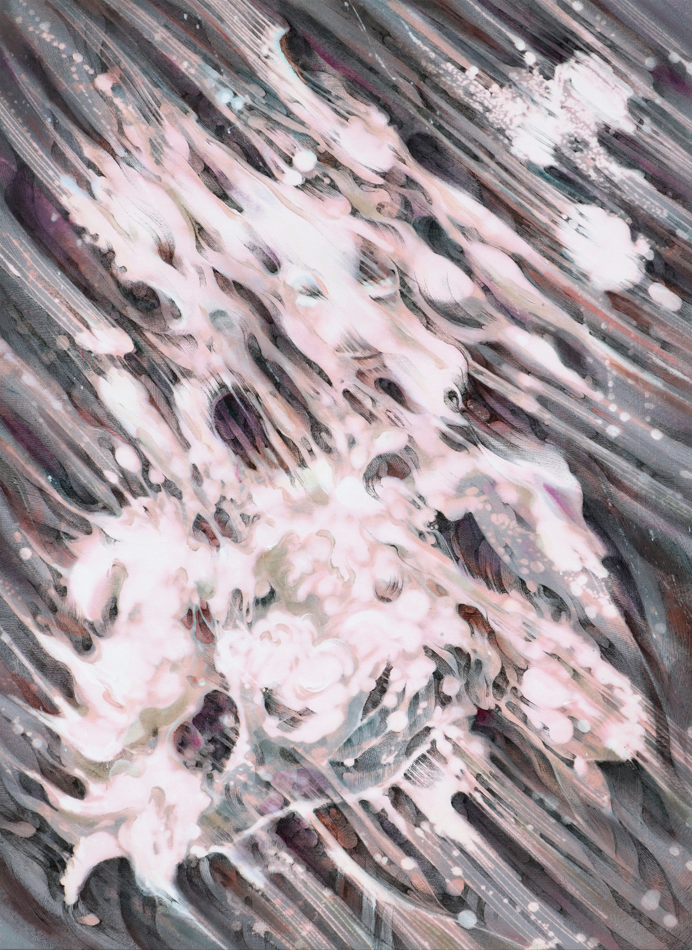
이번 전시에서는 작가가 "표백"이라 부르는 색의 레이어링을 적용한 작업을 대거 선보인다. 무채색의 그림 위에 저채도의 레이어를 얹어 강렬한 흑백 대비를 중화시킨 작업들이다. 이전까지 다원은 표백에 대해 감당하기 힘든 현실을 외면하지 않기 위해 적용하는 자극 중화 작업이라고 소개하고는 했다. 그런데 이번 전시를 준비하는 동안 그 의미에 변화가 생겼다. 작가는 신작들에 대해 이야기하면서, 이제 표백은 감당하기 힘든 현실을 덜 보기 위한 것이 아니라, 다음 단계로 나아가기 위해 대상을 흔적처럼 남기고 작별을 고하는 작업으로 느껴진다고 언급했다. 대각선 방향으로 밀어닥치는 무언가를 표현한 〈페이즈〉(2025) 시리즈는 캔버스나 종이를 표백제로 긁어서 그린 그림들이다. 염소계 표백제의 화학 작용으로 분홍색 얼룩을 남긴 이 그림들은 형상 자체만 본다면, 맹렬한 먼지 바람을 그린 것 같기도 하고, 쏟아지는 유성우를 그린 것 같기도 하며, 씻겨져 나가는 고점도의 거품을 그린 것 같기도 하다. 그런데 최근 작가가 겪은 일과 결부 지어 생각하면, 무언가 타오르는 화염을 그린 것처럼 보인다. 몇몇 그림에서 나타나는 반짝임은 그 무언가가 연소 과정에서 분해되며 떠나가는 기억을 은유하는 것처럼 보이기도 한다.
작년 말, 다원이 키우던 개가 19세를 일기로 세상을 떠났다. 2-30대를 함께 보낸 존재의 사라짐은, 최근 들어 가파르게 쇠약해지는 모습을 보며 각오하고 있었다 해도 큰 충격이었을 것이다. 하늘이 무너지고 해일이 밀어닥치는 환영이 펼쳐지는 제단을 그린 듯한 〈위시〉(2026)는 그 일을 가장 직접적으로 묘사한 그림이다. 2025년 11월 26일 밤, 전날부터 종일 발작과 신음을 반복하던 개가 단말마의 비명을 지르고는 숨을 거두었다. 견딜 수 없는 슬픔과 고통이 온몸에 진동하고 있을 때, TV에서 누리호 발사 성공 뉴스가 나왔다. 그리고 온 세상이 기쁨과 환호로 터져 울리기 시작했다. 어떤 의도도 없는 우연의 일치이지만, 의미와 감정이 너무 모질게 충돌하는 일이었다. 화장터로 갔다가 돌아오는 길에도 기이한 우연과 아이러니가 거듭 들이쳤고, 다원은 당시에 겪었던 극심한 혼돈을 다양한 그림으로 재생하며 재경험하고 있다. 그러던 중 문득 말했다. "그림을 그려서 다행이다."
전시 구성은 '두 갈래로 전개되는 서사'로 잡았다. 풀어서 말하자면 이러하다. 디귿자를 이루는 전시장의 가운데 벽에서 시작한 이야기가 좌우의 벽으로 각기 다르게 펼쳐지는데, 각 전개가 맞은편의 전개와 서로 엇갈리면서도 오묘하게 대응하는 구조. 가운데 벽에는 두 작품을 배치하였다. 사납게 뻗은 절벽을 그린 〈제42화 변곡점〉(2026)과 국화 꽃다발을 안고 장례식장으로 걸어가던 기억을 담은 초기 표백 작업인 〈표백지대〉(2023)다. 옆으로 뻗어 나가듯 가로로 긴 두 그림이 좌우로 펼쳐지며 이야기를 시작한다. 왼쪽으로는 〈페이즈〉 시리즈를 크기순으로 배치하여 점진적으로 작아지다 사라지는 뉘앙스를 풍긴다. 오른쪽으로는 보다 알아보기 쉬운 이미지가 그려진 그림들을 위아래로 지그재그를 그리도록 배치하여 각각의 이야기가 어우러져 이루는 리듬을 전한다.
관객의 온전한 전시 경험을 위해 작품들의 내용에 관한 이야기는 더 하지 않기로 한다. 다원의 그림은 작가에게 그러하였듯 이해하기 어려운 무언가가 내면에 일으키는 혼돈을 자신의 경험적, 신체적, 정서적 여건 속에서 스스로 소화해 나갈 때 가장 깊은 영감을 나누어 주기 때문이다. 전시를 기획하고, 전시에 관한 글을 쓰기 위해 다원이 그간 해 온 작업들을 살펴보면서 이런 이미지가 떠올랐다. 긴 시간 의식 불명 상태로 누워 있던 사람이 어느 날 문득 깨어나 당혹스럽게 주변을 둘러 보다 서툰 움직임으로 조심스럽게 내딛는 발걸음. 그러면서도 갓 태어난 아이처럼 세상의 여러 가지 것들이 신기하고 아름다워 매혹되는 표정. 고통이 거듭되는 삶과 세상을 그럼에도 불구하고 사랑하여 끌어안는 사람의 품. 살다 보면 이따금 또는 자주 시련을 겪게 된다. 찾아온 시련은 물리칠 수 없다. 온전히 마주할 때까지 내 주변을 맴돈다. 오래 내버려 두면 폭풍이 되기도 한다. 하지만 그 눈을 정확히 응시하면 점차 소요는 잦아들고 마침내 고요가 찾아온다. 다원은 자신이 겪은 삶의 미스터리를 가능한 그대로 시각화하는 작업을 통해 그 경험의 기회를 나누고자 한다. 그 자리에 당신을 초대하며, 환영사로 다원의 작업과 공명하는 신지학자 야코뷔스 요하너스 레이우의 문장을 빌린다.
"삶의 신비는 풀어야 할 문제가 아니라, 경험해야 할 현실이다."
DAWON Solo Exhibition 《ABRASAX》 Director Statement
Chaos Drawing
BAC HO UN, director of ICG
DAWON’s paintings are mysterious. Rendered with crisp lines and concrete forms, they nevertheless register like abstraction. The figures in her images seem less intent on declaring themselves than on hinting at something else—and it is difficult to grasp what that “something” might be. The same holds even when one reads the artist’s texts appended as captions or fragments within the work: the anecdotes may reveal the sources of certain components, but they do not quite explain the logic by which the image has been composed. These pictures seduce with a singular beauty, yet they do not offer themselves up in an “easy” conversation. What do they mean? What, exactly, is the artist trying to say? To look beyond the surface of chaos DAWON draws, let’s trace her work in reverse—moving from its formal edges toward its inner core.
DAWON’s practice begins with drawing and extends across works on paper and canvas, installation, and sculptural form. At times she completes a pen drawing as it is; at others she entwines it with space to generate new tension or context; elsewhere she reconfigures it into three-dimensional form through folding, slotting, and assembling. Among these, installation as spatial staging is not secondary to drawing but a primary method—one that actively produces meaning. Broadly speaking, her strategies can be grouped into three approaches: (1) placing multiple drawings at measured intervals or with partial overlaps; (2) working with—or working against—the shape and constraints of the exhibition space; and (3) emphasizing the drawings’ objecthood through custom supports that follow their irregular contours, or through volumetric structures that articulate three-dimensional relationships between images. DAWON often anticipates these spatial decisions already at the drawing stage: she may split a single image across multiple sheets, partition one sheet into distinct zones for different images, or attach fragments of another drawing onto a primary sheet.
These staging methods—introducing boundaries and distances between images—allow the work to hold space both within and around itself. That space is inspired by the “gutter” in printed comics: the gap between panels. Comics construct narrative by arranging framed scenes, and readers complete the story by inferring the hidden links between panels through the gutter. Likewise, the spaces DAWON leaves invite viewers to fill them with imagination, bringing the work’s meaning-making to completion. Inverting the irony that a picture can function like a wall in the act of looking, she creates a kind of pictorial absence—an opening through which the viewer can pass, like a door, into the interior of an image or between images. In this way, DAWON mediates the viewer’s freedom as a device that encourages active, self-directed looking.
Now, let us narrow our focus to the drawing itself. DAWON draws on supports that are often heavily textured—paper or canvas with pronounced tooth—and she favors sharp, pointed writing instruments such as gel pens, dip pens, and ballpoint pens. Such surfaces resist the pen; but the line, pressed through that resistance, carries a corresponding force. In her work, even long strokes drawn across broad canvases retain a palpable “hand”—not only through their speed and unhesitating trajectory, but because the marks also register as wounds to the support, reflecting back the line’s depth and pressure. Here, the scratches are not incidental byproducts of drawing; they are the material disclosure of intention. DAWON visualizes difficult-to-digest events, emotions, and thoughts in order to face, observe, and understand them—and the physical resistance encountered in drawing corresponds to the psychological resistance of confronting reality. The scratches, then, are the material traces of an inner struggle, and of the pain entailed by the process itself. Their significance deepens further when considered alongside the reasons she chooses drawing in the first place.
For DAWON, drawing is, as a mode of expression, more direct, more immediate, and more incisive than any other. On this basis she works with a finely tuned, real-time precision; the drawing becomes a site where her concerns set lines and forms into motion. She also embraces the medium’s disadvantages as essential to her practice. Unlike painting, drawing cannot easily cover over mistakes: every choice and every error accumulates transparently. This demands a sharpened, wakeful state—and the depicted forms absorb that tension as a kind of force. This does not mean she never errs. Sometimes tension becomes too tight; sometimes it loosens—and something slips. When it does, a new line begins from that mistake. Not only errors but every uninvited intrusion can become a pivot: humidity in the paper that alters ink absorption, a stray thought arising mid-stroke, sudden bodily discomfort, and more. Through this active receptivity, the image grows more complex and more enigmatic, forming DAWON’s distinctive, mysterious style. For her, drawing is not the printing-out of a pre-decided image; it is an act of becoming a subject who recognizes the present and moves through change. In that way, DAWON exists—precisely—here and now.
The exhibition title Abrasax emerged as I thought about DAWON’s working attitude. Abrasax (ΑΒΡΑΣΑΞ), mentioned in Gnostic writings, carries multiple meanings. Because it appears across sources as everything from a magical formula to an abstract concept to a divine name, it resists a single, definitive definition; yet that very conceptual turbulence felt suited to the artist’s temperament. In this exhibition, we draw on the meaning articulated by Carl Jung. In The Seven Sermons to the Dead, Jung (who spells it “Abraxas,” referring to the same entity) describes Abrasax as the name of a transcendent totality in which all dualities are integrated—truth and falsehood, fullness and emptiness, creation and dissolution, light and darkness, God and devil. DAWON’s life and work move forward in a zigzag, buffeted by reality, yet she affirms every bend: suffering as suffering, joy as joy. There is a direction that forms when one advances without screening out what comes. To that vanishing point, we give the name Abrasax.
This exhibition also presents, in significant number, works that apply a chromatic layering the artist calls “bleaching.” Over monochrome drawings, she lays low-saturation layers to temper the stark contrast of black and white. Until now, DAWON has described bleaching as a way of neutralizing stimuli so as not to look away from a reality that is difficult to bear. But while preparing this exhibition, the meaning shifted. Speaking of the new works, she noted that bleaching no longer feels like a way of seeing less; rather, it feels like leaving the subject behind as a trace—saying goodbye—in order to move on to the next stage. The Phase (2025) series, which evokes something rushing in diagonally, is made by scraping canvas or paper with bleach. Chemically, chlorine bleach leaves pinkish stains; formally, these works might suggest a fierce dust storm, a shower of meteors, or viscous foam being washed away. Yet when read in relation to what the artist has recently lived through, they begin to resemble flames. In several works, the glimmers that appear seem to metaphorize memories breaking down and departing in the course of combustion.
At the end of last year, DAWON’s dog—whom she had raised—passed away at the age of nineteen. Even if one has braced oneself while watching a beloved companion rapidly weaken, the disappearance of a being who shared one’s twenties and thirties must still arrive as a profound shock. Wish (2026) is the work that most directly depicts that event, like an altar on which visions unfold—sky collapsing, a tidal wave surging in. On the night of November 26, 2025, after a full day of seizures and groans that had begun the day before, the dog let out a final cry and died. As unbearable grief and pain trembled through her body, news of the Nuriho launch’s success appeared on television—and the whole world seemed to erupt in celebration and cheers. It was a coincidence without intention, yet one in which meaning and emotion collided with brutal force. On the way back from the crematorium, strange coincidences and ironies continued to press in. DAWON is now replaying—and re-experiencing—the extreme confusion of that time through a range of images. At one point she said, quietly: “I’m glad I draw.”
The exhibition is structured as a narrative that unfolds along two branching paths. In concrete terms: a story begins on the central wall of the ㄷ-shaped gallery space and then spreads differently to the left and right walls—each development crossing and yet subtly corresponding to the other. Two works are placed on the central wall: Episode 42: Singularity (2026), which depicts a cliff thrusting out with ferocity, and Bleached Spots (2023), an early bleaching work that holds the memory of walking to a funeral carrying a bouquet of chrysanthemums. These two horizontally extended works initiate the story as they expand outward to both sides. On the left, the Phase series is installed in order of size, creating a nuance of gradual diminishment—shrinking until it disappears. On the right, works with more readily legible imagery are arranged in a vertical zigzag, conveying the rhythm produced as individual narratives braid together.
For the sake of the viewer’s experience, I will not say more about the specific content of the works. DAWON’s images, as they were for the artist herself, share their deepest inspiration when something difficult to understand stirs chaos within—and one processes it, on one’s own terms, through the conditions of one’s lived experience, body, and emotions. As I reviewed DAWON’s practice to plan this exhibition and write about it, one image came to mind: a person who has lain unconscious suddenly waking one day, looking around in bewilderment, then placing tentative steps with awkward movement; and yet, like a newborn, becoming captivated by how strange and beautiful the world’s many things are. It is the embrace of someone who, despite repeated pain, loves life and the world and holds them close all the same. In living, we encounter trials—sometimes rarely, sometimes often. One cannot simply drive them away; they circle until we face them fully. Left unattended, they can become a storm. But if we meet their gaze exactly, the turmoil subsides, and calm finally arrives. Through works that visualize the mysteries of a life she has lived as directly as possible, DAWON seeks to share the opportunity of that experience. I invite you into that space, and in lieu of a welcome address, I borrow a sentence by the theosophist Jacobus Johannes van der Leeuw, which resonates with DAWON’s work:
“The mystery of life is not a problem to be solved; it is reality to be experienced.”
